

Heat pump vs iHot: an honest comparison
Both a heat pump and iHot can cut the cost of hot water, one of the biggest energy costs in most Australian homes. They work very differently, and each is the better choice for different homes. Here's a straight comparison, including where a heat pump beats iHot.
The short answer
- Choose a heat pump if you have limited or shaded roof space, live somewhere cool and cloudy, use most of your hot water at night, or want the lowest energy use per litre of hot water.
- Choose iHot if you have a working electric tank and room for a few dedicated panels, are off-grid or want to protect a home battery, have hit your network's solar export limit, or want a silent system with no compressor or refrigerant.
How each one works
A heat pump works like a fridge in reverse. A compressor and fan pull heat from the outside air into the water. For every 1 kWh of electricity it uses, a good heat pump delivers roughly 3.5 to 5 kWh of heat.
iHot connects its own dedicated solar panels to your existing electric tank's heating element through a standalone solar water heating inverter. The element turns 1 kWh of electricity into 1 kWh of heat. That electricity comes from panels that do nothing else, and the grid tops up only when the sun can't keep up. iHot never draws from or diverts your house solar.
Side by side
| Heat pump | iHot + electric tank | |
|---|---|---|
| Electricity per kWh of heat | About 0.2 to 0.3 kWh (very efficient) | 1 kWh, supplied by dedicated solar |
| Solar panels for a 4-person home (Brisbane) | None required; about 0.5 kW if you want to run it from your house solar | 6 to 8 dedicated panels |
| Typical installed cost | About $3,000 to $5,000 before rebates; you replace your tank | About $2,000 to $3,000 after STCs, including 6 to 8 panels; you keep your existing tank |
| Federal STCs | Typically $800 to $1,200 | About $800 to $1,000, earned on the dedicated panels |
| State programs | Available in several states; check current programs | May be eligible in VIC, NSW, SA and QLD; check with your installer |
| Works at night | Yes, from the grid or a battery | Via grid boost only |
| Cloudy days and winter | Keeps working; efficiency dips in frost | Cold air doesn't matter, but weaker sun means more grid boost |
| Noise | Compressor and fan, similar to a small air conditioner | Silent |
| Moving parts and refrigerant | Compressor, fan and refrigerant circuit | None; solid-state and IP68 rated |
| Load on an off-grid battery | Yes | None; runs from its own panels |
| Solar export limits | Not relevant unless you add panels to run it | Not affected; iHot's panels never export |
| Warranty and life | Typical life about 10 to 15 years | 5-year warranty on the iHot unit, the same as most tanks |
Where a heat pump wins
- Efficiency. A heat pump needs about a quarter of the electricity for the same hot water. If you count every kWh, it is the more efficient way to heat water.
- Roof space. iHot needs 6 to 8 dedicated panels for a typical family. If your roof is small, shaded or already full, a heat pump is the better fit.
- Night and winter. A heat pump keeps working efficiently from the grid. iHot relies on grid boost at the normal element rate when the sun is weak.
- Existing large solar systems. If you already have plenty of surplus house solar and no export limit problem, a heat pump on a timer can use it without adding panels.
Where iHot wins
- Off-grid and battery homes. iHot heats water from its own panels, so it never drains your battery or loads your inverter.
- Export limits. Because iHot's panels never export, they aren't affected by your network's solar limits. You can add iHot even if your house system is already at its cap.
- Silence. No compressor or fan, so it can sit beside bedrooms, decks or the neighbour's fence.
- Simplicity. No refrigerant, compressor or fan to wear out. The tank stays a standard electric tank any plumber can service or replace.
- Keep your tank. If your electric tank is in good condition, you don't throw it away. iHot can also be fitted to many solar and heat pump tanks via their backup element, at your installer's discretion.
- Lower upfront cost. About $2,000 to $3,000 installed after STCs for a typical 6 to 8 panel system.
Real retrofits on existing tanks
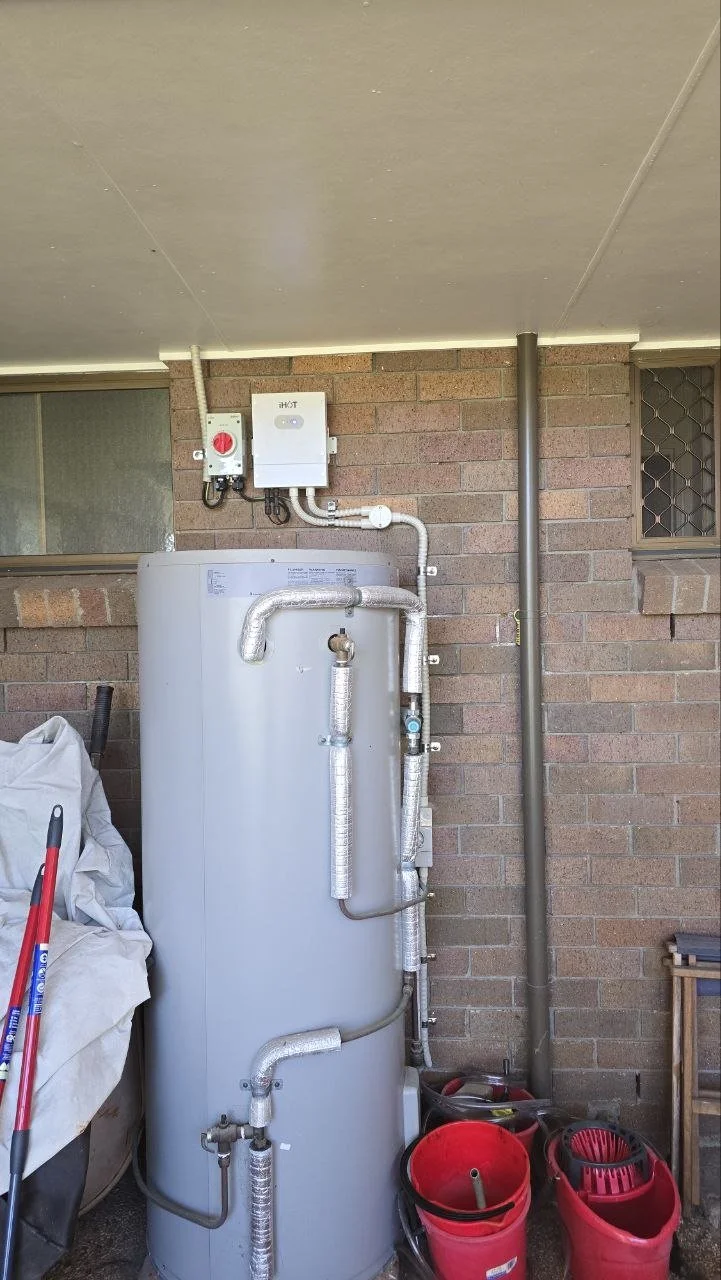
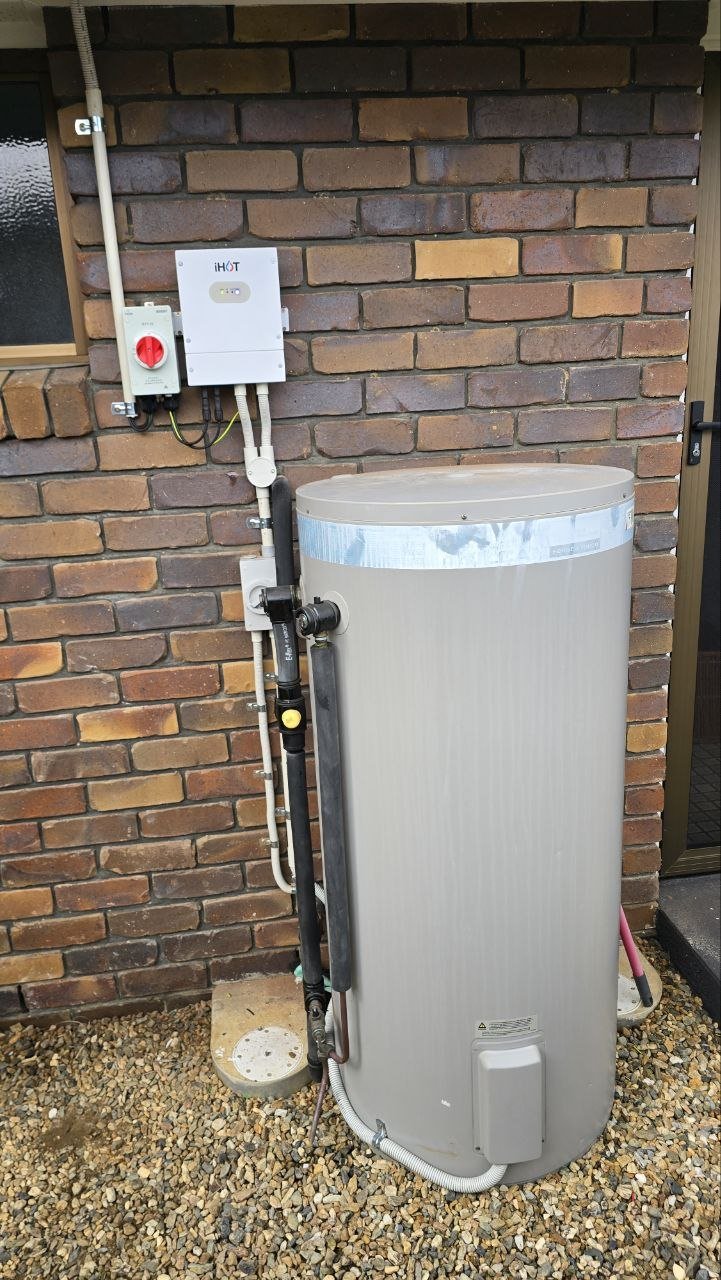
What it costs to run
Running cost depends on your hot water use, tariff, roof and climate, so treat any single number with caution. For a typical 4-person home in Brisbane, iHot could save up to around $800 a year compared with a plain electric tank on the grid. That assumes about 8 kWh a day of hot water at 30c/kWh on a standard tariff, with 85% to 95% of it heated by up to 8 x 475 W north-facing panels and the rest by grid boost. If you're already on a cheaper off-peak (controlled load) tariff, your saving will be lower.
A heat pump in Queensland typically costs a couple of hundred dollars a year to run from the grid, and less if it runs on a timer from your house solar.
For upfront, yearly and 10-year costs of every option, including gas, rooftop solar thermal and PV diverters, see the cheapest way to heat water in Australia.
Still not sure?
Send us your postcode, household size, tank details and a photo of your roof. We'll tell you honestly whether iHot or a heat pump suits you better.
Get an installed price · Contact us · Find an installer · How iHot works